
INTRODUCTION
Motion isn’t a garnish. It’s a UX system.
If your scroll animation drops frames, your interface feels broken. If your parallax is too aggressive, people feel nauseous. If your fancy transitions steal focus, keyboard users get trapped. The uncomfortable truth: a lot of “premium” motion on the modern web is hostile by default.
This article translates experimental interaction trends (Awwwards/Codrops energy) into a concrete, shippable accessibility playbook—with prefers-reduced-motion, motion intensity tiers, and engineering guardrails that keep your site fast and inclusive.
Motion is UX—not decoration
Good motion does three jobs:
- Explain change (what just happened, where did it go?)
- Guide attention (what matters next?)
- Confirm causality (your action caused this outcome)
Bad motion does the opposite: it competes with content, introduces delay, and creates physical discomfort.
A decision framework: when motion helps vs. distracts
Before animating anything, run it through this quick set of heuristics.
Motion helps when it…
- Reduces cognitive load: e.g., a subtle expand/collapse that shows hierarchy.
- Improves perceived performance: e.g., skeleton loading or a lightweight progress indicator.
- Clarifies spatial relationships: e.g., a card expands into a detail view.
- Provides immediate feedback: e.g., button press states, form validation hints.
Motion distracts (or harms) when it…
- Blocks reading: text moving while users try to scan.
- Hijacks scrolling: scroll-jacking, pinned animations that fight the user.
- Creates continuous background motion: looping parallax, drifting noise layers.
- Surprises users: sudden zooms, rapid oscillation, camera-like movement.
Rule of thumb: If motion doesn’t improve comprehension or feedback, it’s likely decoration—and decoration should be the first thing to scale down for accessibility and performance.
The “motion budget” mindset
Studios already use performance budgets (KB, LCP, CLS). Apply the same discipline to motion:
- Max duration for UI feedback: ~150–250ms (micro-interactions)
- Max duration for transitions: ~200–500ms (page/route transitions)
- Max distance for UI shifts: keep it small; avoid large travel for essential controls
- Max simultaneous animations: fewer is better; prioritize one focal animation at a time
The accessibility checklist for animation
Accessibility-first motion design isn’t just “add prefers-reduced-motion.” It’s a set of defaults.
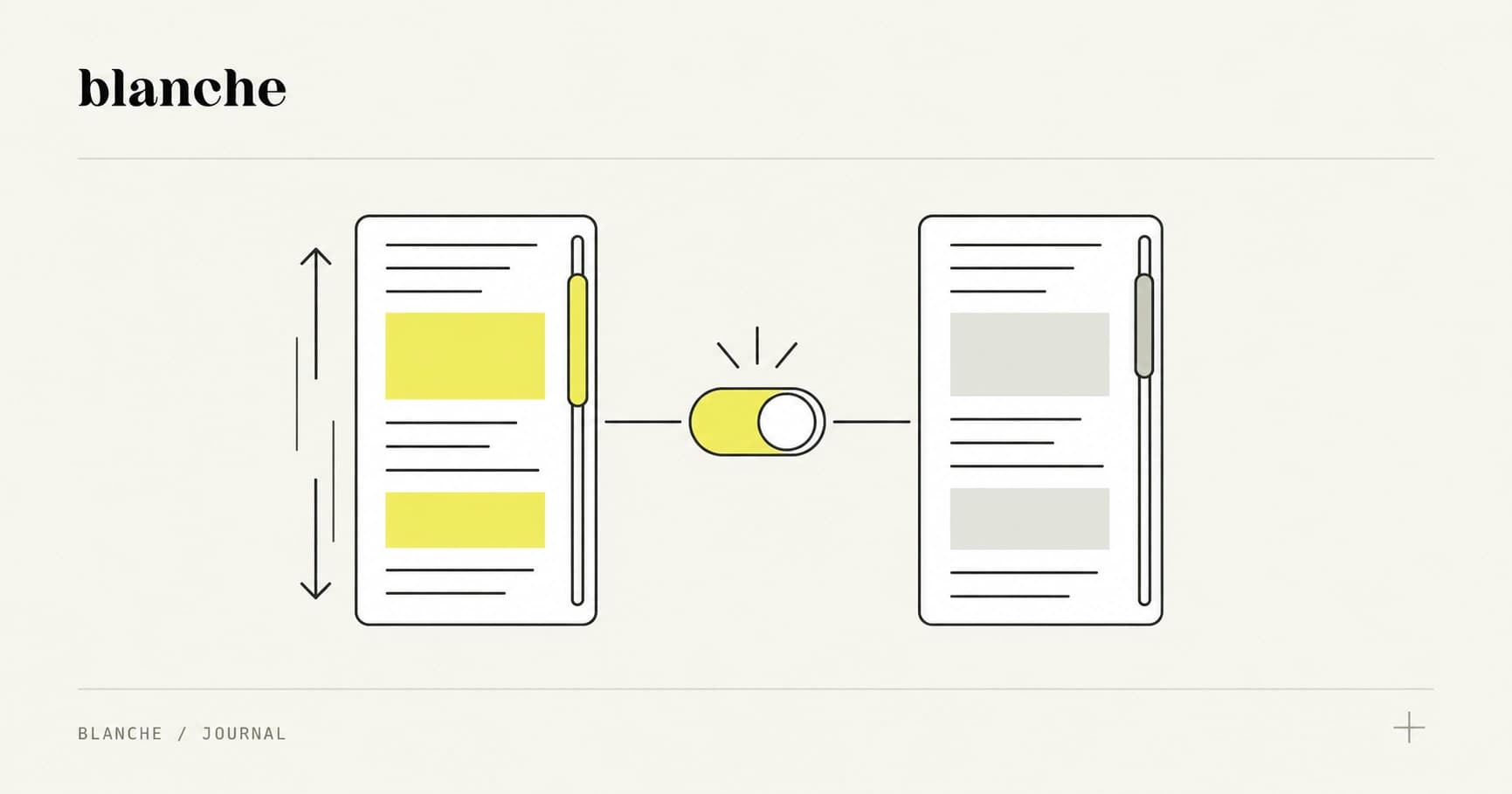
1) Honor prefers-reduced-motion (and don’t punish users for it)
Users who enable reduced motion shouldn’t get a broken experience or a “lesser” UI. They should get a stable, readable, fully functional experience.
Core approach:
- Default: tasteful motion
- Reduced motion: remove non-essential motion, keep essential state changes
@media (prefers-reduced-motion: reduce) {
  *, *::before, *::after {
    animation-duration: 0.001ms !important;
    animation-iteration-count: 1 !important;
    transition-duration: 0.001ms !important;
    scroll-behavior: auto !important;
  }
}
This blunt reset is a good baseline, but it’s not the whole solution. You still need intentional fallbacks for scroll-driven storytelling and parallax.
2) Create motion “intensity tiers” (a studio-wide standard)
Instead of a binary “motion on/off,” define tiers your team can implement consistently.
A practical tier system:
- Tier 0 (Reduce): no parallax, no scroll-linked transforms, no autoplay video; instant state changes
- Tier 1 (Subtle): opacity fades, small transforms (<8px), short durations; no continuous motion
- Tier 2 (Expressive): richer transitions, staggered reveals, limited scroll-linked effects
- Tier 3 (Experimental): heavy storytelling, pinned sections, complex sequences (use sparingly)
Implementation pattern (CSS variables + data attribute):
:root {
  --motion-multiplier: 1;
}

html[data-motion="reduce"] { --motion-multiplier: 0; }
html[data-motion="subtle"] { --motion-multiplier: 0.6; }
html[data-motion="expressive"] { --motion-multiplier: 1; }

.card {
  transition: transform calc(200ms * var(--motion-multiplier)) ease,
              opacity calc(200ms * var(--motion-multiplier)) ease;
}

html[data-motion="reduce"] .card {
  transition: none;
}
Then set the attribute in JS based on system preference, with an optional user toggle saved in localStorage.
3) Avoid vestibular triggers
Certain motion patterns are more likely to cause nausea or dizziness:
- Parallax with large depth deltas (background moves much slower/faster than foreground)
- Zooming/scaling the entire viewport
- Rotation and oscillation
- Scroll-tied motion that doesn’t match finger/trackpad feel
Mitigations:
- Keep parallax offsets small (think single-digit pixels, not 100px hero drifts)
- Prefer opacity and subtle translateY over scale/rotate
- Avoid continuous ambient motion behind text
4) Protect keyboard and assistive tech flows
Motion often breaks accessibility indirectly:
- Focus rings hidden by transforms/overlays
- Off-canvas panels that don’t trap focus correctly
- Scroll-jacked sections that prevent normal keyboard scrolling
Baseline requirements:
- Use semantic HTML for controls (real
<button>,<a>) - Ensure focus is visible at all times
- For overlays/modals: implement focus trap,
aria-modal, and restore focus on close - Don’t animate elements in a way that moves focus out from under the user
If your animation changes layout, test it with Tab/Shift+Tab before you call it done.
Patterns that work: micro-interactions, transitions, and storytelling
You can still build modern, high-craft experiences—without making motion the cost of entry.
Micro-interactions: the safest place to be expressive
Micro-interactions are small, local, and user-triggered—ideal for accessibility.
Use them for:
- Button press/hover feedback
- Form validation (subtle color + icon + small movement)
- Copy-to-clipboard confirmation
- Menu open/close states
Guidelines:
- Keep it fast (150–250ms)
- Keep movement small (2–8px)
- Pair motion with non-motion cues (color, text, icon)
Example: button feedback without gimmicks
.button {
  transform: translateZ(0);
  transition: transform 180ms ease, background-color 180ms ease;
}
.button:active {
  transform: translateY(1px);
}

@media (prefers-reduced-motion: reduce) {
  .button { transition: background-color 180ms ease; }
  .button:active { transform: none; }
}
Transitions: make navigation feel coherent (without slowing it down)
Page transitions can improve perceived quality, but they’re also where teams overdo it.
What works:
- Crossfade + slight translate on key containers
- Keep navigation responsive; don’t lock the UI behind long sequences
- If you use route transitions (Next.js/React), ensure focus moves to the new page heading
Concrete takeaway:
- Animate one layer (the content container), not the entire DOM.
- Always preserve readability: avoid moving large paragraphs.
Scroll storytelling: use it like a dial, not a rollercoaster
Scroll-driven experiences can be great for product narratives, data stories, and portfolios. The failure mode is treating scroll like a video timeline.
Accessibility-first scroll storytelling:
- Prefer discrete steps (snap points / section reveals) over continuous scrubbing
- Keep motion secondary to content: the story should still work as a static page
- Provide an escape hatch: don’t trap users in pinned sections
If you’re inspired by Codrops demos, treat them as R&D prototypes. The production version needs fallbacks.
Engineering it: CSS/JS techniques and performance budgets
Most motion accessibility problems show up as performance problems first: jank, delayed input, broken scrolling.
Performance guardrails (what to standardize in your studio)
Prefer GPU-friendly properties
Animate:
transform(translate)opacity
Avoid animating:
top/left(layout)width/height(layout)filter(often expensive)- large
box-shadowchanges (paint heavy)
Use compositing intentionally
will-change can help, but overusing it increases memory usage.
- Apply
will-change: transformonly to elements that actually animate - Remove it when no longer needed (especially for long pages)
Don’t tie heavy work to scroll events
The classic pitfall: window.addEventListener('scroll', ...) + DOM reads/writes each frame.
Better options:
- Use IntersectionObserver for reveal-on-enter patterns
- Use requestAnimationFrame for scroll-linked transforms (and keep computations tiny)
- Consider the emerging Scroll-Driven Animations API (
scroll-timeline) where supported, with fallbacks
Example: reveal on enter (cheap and accessible)
const items = document.querySelectorAll('[data-reveal]');

const io = new IntersectionObserver((entries) => {
  for (const e of entries) {
    if (e.isIntersecting) e.target.classList.add('is-visible');
  }
}, { threshold: 0.2 });

items.forEach(el => io.observe(el));
[data-reveal] {
  opacity: 0;
  transform: translateY(8px);
  transition: opacity 240ms ease, transform 240ms ease;
}
[data-reveal].is-visible {
  opacity: 1;
  transform: translateY(0);
}

@media (prefers-reduced-motion: reduce) {
  [data-reveal] { opacity: 1; transform: none; transition: none; }
}
Parallax without nausea (and without scroll-jank)
If you must do parallax:
- Keep offsets small
- Move backgrounds subtly, not foreground content
- Avoid parallax on text blocks
- Disable it for reduced motion and often for mobile
Implementation tips:
- Use
transform: translate3d(0, y, 0) - Update in
requestAnimationFrame - Cache measurements; avoid layout thrash (don’t call
getBoundingClientRect()repeatedly inside the same frame without need)
Throttling, debouncing, and “do less”
For scroll-linked effects, the goal is not clever code—it’s fewer operations.
- Use
requestAnimationFrameas your throttle - Batch reads then writes
- Avoid triggering style recalculation loops
A simple rAF throttle pattern:
let ticking = false;

function onScroll() {
  if (!ticking) {
    window.requestAnimationFrame(() => {
      // compute minimal transforms here
      ticking = false;
    });
    ticking = true;
  }
}

window.addEventListener('scroll', onScroll, { passive: true });
Set performance budgets that relate to motion
Motion is where you feel performance most.
Studio-ready guardrails:
- Target 60fps for interactive motion (or at least stable 30fps on low-end devices)
- Keep long tasks out of interaction windows (avoid JS spikes during scroll)
- Watch INP (Interaction to Next Paint) alongside LCP/CLS
- Cap animation work per frame: if you can’t explain what runs each frame, it’s too much
Tools teams actually use:
- Chrome DevTools Performance panel (look for long tasks, layout thrash)
- Lighthouse + Core Web Vitals (INP/LCP/CLS)
- WebPageTest (real device traces)
- RUM (SpeedCurve, New Relic, Datadog) to catch real-world jank
Common pitfalls (and how to avoid them)
Pitfall 1: Scroll-jank from layout thrashing
Symptoms:
- Stuttering scroll
- Fans spin up
- Animations lag behind finger/trackpad
Fixes:
- Stop animating layout properties
- Avoid reading layout and writing styles repeatedly in the same tick
- Replace scroll listeners with IntersectionObserver when possible
Pitfall 2: Parallax nausea from excessive depth
Symptoms:
- Users report dizziness
- The page feels like a moving camera
Fixes:
- Reduce amplitude drastically
- Remove parallax behind text
- Turn it off for
prefers-reduced-motionand often for smaller screens
Pitfall 3: Focus/keyboard traps in animated overlays
Symptoms:
- Tab key disappears into the void
- Focus jumps behind a modal
- ESC doesn’t close
Fixes:
- Use a proven dialog approach (e.g., Radix UI Dialog, Headless UI, or native
<dialog>with careful polyfills) - Trap focus while open and restore focus on close
- Don’t animate focusable elements off-screen without managing focus state
QA: how to test motion like a pro
Testing motion isn’t subjective if you make it procedural.
1) Test with reduced motion enabled
- macOS: System Settings → Accessibility → Display → Reduce motion
- iOS: Accessibility → Motion → Reduce Motion
- Windows: Settings → Accessibility → Visual effects → Animation effects
Verify:
- No scroll-linked parallax
- No autoplay motion backgrounds
- Core flows still communicate state (open/close, success/error)
2) Keyboard-only pass
Checklist:
- Can you reach every interactive element?
- Is focus always visible?
- Do overlays trap focus and restore it?
- Do animated sections block normal scrolling?
3) Screen reader sanity check
You don’t need to be a screen reader expert to catch common issues.
- VoiceOver (macOS/iOS), NVDA (Windows)
- Confirm that animated UI doesn’t reorder content unexpectedly
- Ensure announcements exist for dynamic updates (use
aria-livesparingly and intentionally)
4) Performance profiling on a “bad” device
Don’t validate motion on a maxed-out MacBook only.
- Use Chrome CPU throttling
- Test on a mid/low-tier Android device if your audience includes it
- Record a Performance trace while scrolling through your heaviest section
If motion only feels good on your machine, it’s not production-ready.
Conclusion: build a motion system you can defend
The studios doing the best work right now aren’t choosing between “boring accessibility” and “exciting motion.” They’re building a motion system: intentional, tiered, performant, and respectful of user preferences.
Your immediate next steps:
- Adopt motion intensity tiers and bake them into your design tokens/CSS variables.
- Implement prefers-reduced-motion as a first-class experience, not an afterthought.
- Standardize engineering guardrails: transform/opacity, rAF throttling, IntersectionObserver.
- Add a motion QA checklist to every launch: reduced motion, keyboard, screen reader, low-end performance.
If you want, share a link to a page you’re animating (or a prototype). We can map your animations to intensity tiers, identify the highest-risk vestibular triggers, and propose a reduced-motion variant that still feels premium.