
INTRODUCTION
Your UI Was Never Designed for This User
Every interaction model we've refined over the past three decades — affordances, progressive disclosure, visual hierarchy, onboarding flows — was built with one assumption baked in: a human being is on the other end. A person with eyes, habits, cognitive load, and a cursor hovering somewhere on the screen.
That assumption is quietly breaking.
Autonomous AI agents — systems that browse, click, authenticate, extract, and act on behalf of humans — are becoming a real category of product user. Not a hypothetical. Today, tools like Anthropic's Claude with computer use, OpenAI's Operator, and a growing ecosystem of agent frameworks (LangChain, AutoGPT, CrewAI) are doing things like booking appointments, filing expenses, managing GitHub issues, and drafting contracts by navigating the same interfaces your human users touch every day.
The UX community has spent years debating accessibility, internationalization, and responsive design. Agent-readiness is the next frontier — and almost nobody is prepared for it.
What Breaks When an Agent Navigates a Human Interface
When a language model attempts to operate a typical SaaS product UI, it encounters a surprisingly hostile environment. Not because the design is bad — in many cases it's excellent, by every conventional measure — but because it was optimized for a fundamentally different kind of cognition.
Here's what collapses first:
Visual metaphors without semantic grounding. A button that says "Go" means something to a human who has context from the surrounding layout, the product's mental model, and prior sessions. To an agent parsing DOM elements, "Go" is almost meaningless without surrounding semantic structure. Icon-only interfaces are even worse — a trash icon is intuitive to humans but opaque in an accessibility tree stripped of labels.
State communicated through animation. Many modern UIs communicate critical system state — loading, success, error, locked — through motion or color alone. Agents operating through vision models or DOM inspection frequently miss these signals entirely, leading to duplicate submissions, missed errors, or actions taken on stale data.
Implicit flows and modal logic. Human users learn through exploration and pattern-matching. Agents need to reason about what's currently possible. A multi-step wizard that conditionally reveals options based on prior selections creates enormous uncertainty for an agent trying to construct a plan before executing it.
Session assumptions and anti-bot infrastructure. This is the uncomfortable one: a huge amount of modern web infrastructure is specifically designed to detect and block non-human actors. CAPTCHAs, rate limiting, fingerprinting, and behavioral analytics are all working against the very agents your users may now be sending.
The deeper problem isn't that agents are bad at using interfaces. It's that interfaces were never designed to be legible to anything other than human perception.
The Dual-Layer Design Model — Human and Machine in One Product
The instinct to "fix this" by building a separate agent interface is understandable but misguided. Creating a parallel, machine-only API layer and a human-only UI layer sounds clean, but it immediately introduces synchronization debt: every feature ships twice, every change propagates across both surfaces, and the two experiences slowly drift apart.
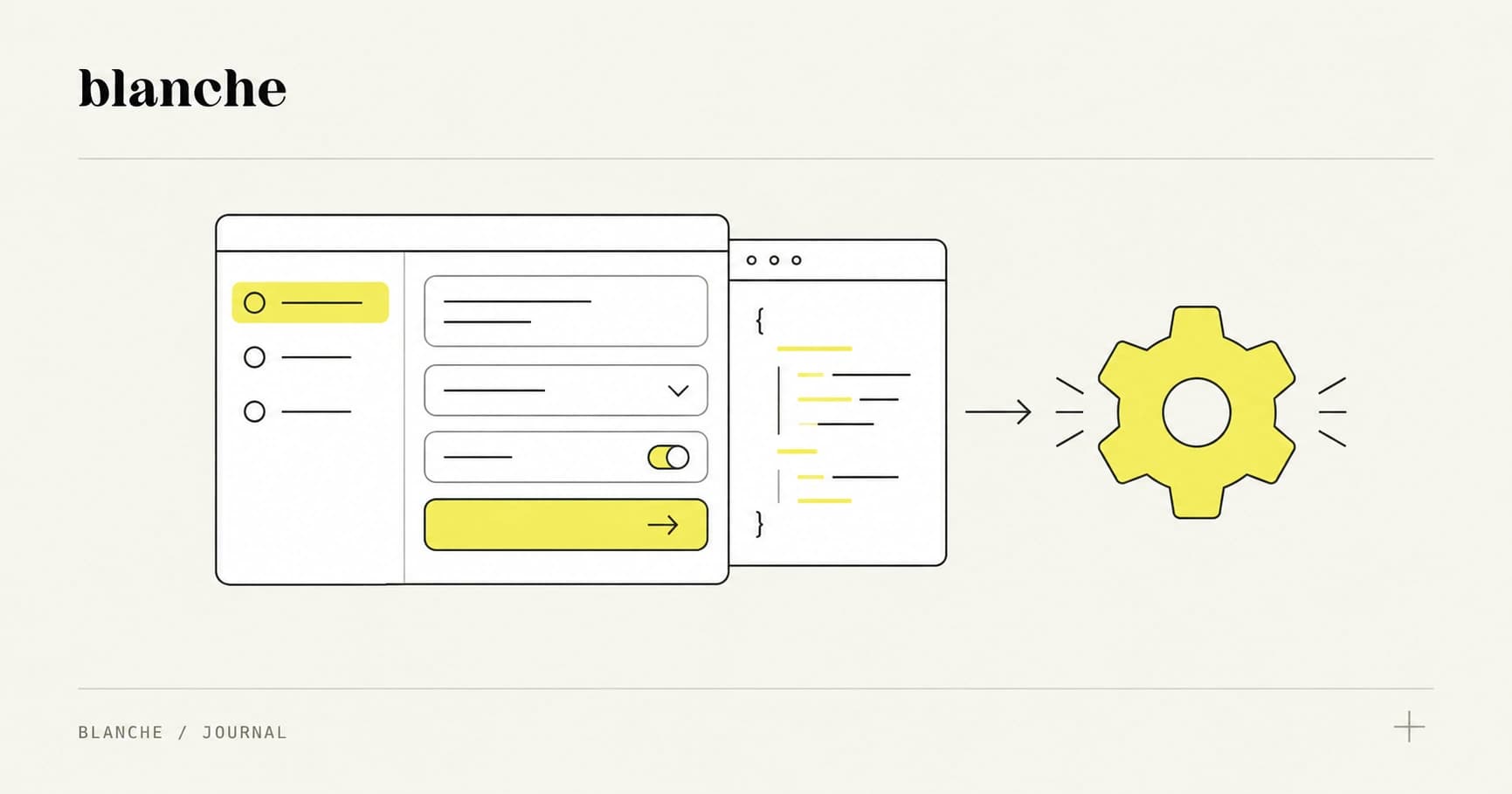
The more sustainable model is dual-layer design — a single product architecture where the human-facing experience and the machine-readable structure are expressions of the same underlying model.
Think of it less like building two products and more like how a well-structured document works: the visual rendering serves humans, while the heading hierarchy, metadata, and semantic tags serve machines. Both layers coexist without contradiction.
In practice, this means:
-
Actions, not just screens. Rather than designing exclusively around pages and navigation, model your product around discrete, atomic actions — create, update, assign, archive, approve. Each action should be expressible both through the UI and through a consistent API call or structured intent.
-
Explicit state surfaces. Build UI states that communicate clearly to both audiences. A task management tool shouldn't just show that a project is locked — it should surface that state in a machine-readable attribute, an accessible ARIA label, and a visible human indicator simultaneously.
-
Structured feedback channels. When an agent completes an action, it needs a reliable success/failure signal. Human users tolerate ambiguity — they can re-read a page and infer what happened. Agents cannot. Design confirmation states that are programmatically unambiguous.
Linear, the project management tool beloved by engineering teams, is an instructive example. Its API-first architecture — where every action in the UI is a direct reflection of an API operation — means that agents can operate Linear with high fidelity. The human experience wasn't compromised; the structural discipline that makes it great for humans also makes it legible to machines.
Semantic, Structured, Agent-Friendly: New Design Primitives
If dual-layer design is the philosophy, these are the practical primitives that make it real:
Semantic HTML — Not Optional Anymore
Proper use of semantic HTML (<button> vs. <div onClick>, <nav>, <main>, <form>) has always been an accessibility best practice. For agent-readiness, it becomes a functional requirement. Agents navigating via DOM inspection or accessibility APIs depend on semantic structure to understand what's interactive, what's informational, and what's navigational.
ARIA Labels with Intent
Go beyond aria-label="Close" and start thinking about expressing intent and context. An ARIA description that reads "Archive this project — removes it from active views but preserves all data" gives an agent the context it needs to decide whether an action is appropriate for its current objective.
Structured Metadata and Schema.org
For content-heavy products, structured data markup is extraordinarily powerful for agents. If your product surfaces invoices, events, products, or people, marking them up with Schema.org vocabulary makes them instantly parseable — not just for AI agents, but for search engines, voice interfaces, and integrations.
Capability Manifests
Borrowing from the world of APIs, some teams are beginning to experiment with capability manifests — machine-readable documents (think OpenAPI specs but for UI actions) that describe what a product can do, what permissions are required, and what outcomes to expect. Notion's API documentation and Stripe's remarkably clear event taxonomy are early precedents for this kind of structured legibility.
Trust Architecture — Communicating Intent and Permission
Here's where agent-ready design gets genuinely hard: trust.
When a human uses your product, the consent and permission model is relatively straightforward. The user authenticates, accepts terms, and takes actions. Responsibility is clear.
When an agent acts on a user's behalf, you suddenly have a three-party system: the human principal (who delegated the task), the AI agent (who is executing it), and your product (which has to decide what to allow). The conventional permission model buckles under this weight.
Designing for trust in an agentic context means addressing several distinct challenges:
Scope visibility for human supervisors. Humans who deploy agents need to understand, at a glance, what an agent has done, is doing, and is authorized to do. This argues for a new class of UI component — an audit trail or agent activity feed that's designed not as a forensic tool but as a live supervisory surface.
Permission granularity. Broad OAuth scopes ("read and write access to your account") are insufficient. Agentic contexts demand fine-grained, action-level permissions: "This agent can create tasks but cannot delete projects or modify billing." Stripe's API key permission system — where keys can be scoped to specific resources and actions — is a strong model to draw from.
Reversibility signals. Agents benefit enormously from knowing which actions are reversible and which are permanent. Designing your action system with explicit reversibility metadata — and surfacing that in both human-readable and machine-readable form — creates a natural safety layer.
Confirmation friction as a feature. Counter-intuitively, introducing deliberate confirmation steps for high-stakes or irreversible agent actions isn't friction — it's trust infrastructure. A well-designed confirmation modal that clearly describes what will happen and who authorized it becomes a meaningful checkpoint in the human-agent workflow.
Trust in agentic systems isn't just a security concern — it's a design discipline. The products that earn it will be the ones that made legibility and control first-class design values, not afterthoughts.
The Designer's Role in an Agentic Internet
The arrival of AI agents as a product user class doesn't diminish the importance of design — it radically expands its scope.
For product designers and UX leads, this moment demands a shift in mental model. You are no longer designing only for human perception and cognition. You are designing the rules of engagement for an increasingly automated world — one where the quality of your semantic structure, the clarity of your action model, and the thoughtfulness of your permission architecture will determine whether your product thrives in an agent-mediated future or becomes a walled garden that automation routes around.
For product managers, this is a prioritization conversation that needs to happen now. "Agent-readiness" isn't a feature — it's a quality attribute, like performance or accessibility. It should be baked into design reviews, API decisions, and the vocabulary of what "done" means.
The companies that will win the next decade of digital product design aren't necessarily the ones with the most beautiful interfaces. They're the ones that understood, early, that great design for humans and great design for machines are not opposites — they're the same discipline, practiced with more rigor.
The interface layer is getting thinner. The structural layer has never mattered more. Now is the time to design accordingly.