
INTRODUCTION
The Hero Section Is Dead — Long Live the Experience
Picture every brand website you've visited in the last six months. Chances are, you can recall maybe one or two. The rest dissolved into the same visual fog: a full-bleed photograph, a tagline in bold sans-serif, a CTA button in brand blue. The static hero section — once the crown jewel of web design — has become wallpaper.
This isn't hyperbole. With over 1.1 billion websites currently active and the average user forming a design impression in 50 milliseconds, visual sameness is a brand crisis hiding in plain sight. The question isn't whether your hero section is beautiful. It's whether it moves — literally and figuratively.
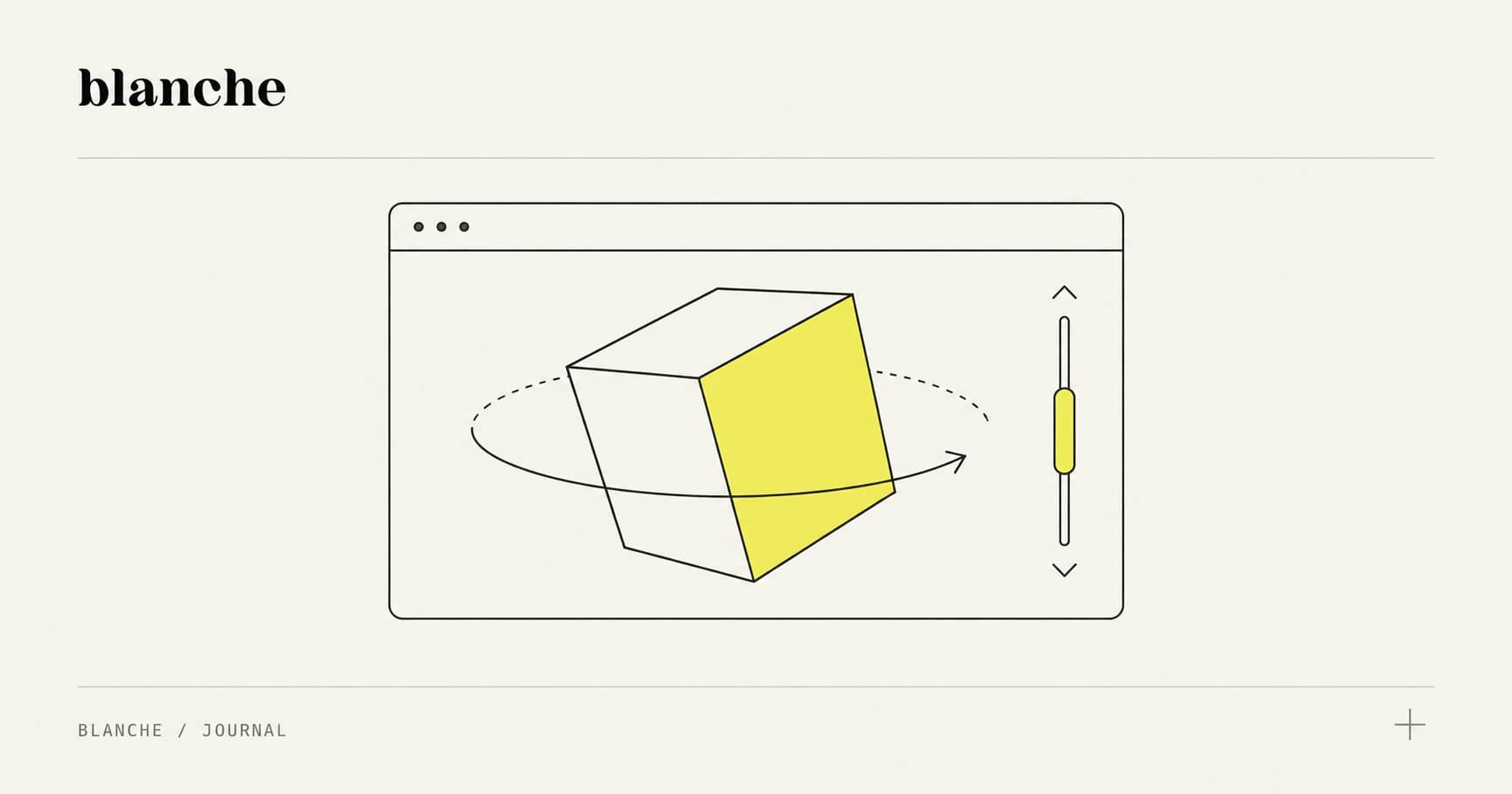
Enter scroll-driven WebGL storytelling: a paradigm shift that transforms the act of scrolling from a navigation gesture into a narrative engine. Instead of presenting a brand, these experiences unfold a brand — scene by scene, frame by frame, with the user as director.
This is the new frontier for creative agencies and frontend teams willing to push past templates and into genuine cinematic craft.
The Rise of Scroll-Driven 3D: What's Fueling the Trend
The appetite for immersive web experiences didn't appear overnight. It's the convergence of several forces that have matured simultaneously:
Hardware caught up with ambition. Modern GPUs — even in mid-range laptops and flagship mobile devices — can handle real-time 3D rendering at frame rates that would have been impossible five years ago. The browser is no longer the bottleneck it once was.
WebGL democratized GPU access. What was once confined to native apps and game engines now runs natively in Chrome, Firefox, and Safari with zero installation friction. Libraries like Three.js abstracted away the complexity, opening the door for frontend developers who never wrote a shader in their lives.
Scroll behavior became an interaction primitive. GSAP's ScrollTrigger, Locomotive Scroll, and Lenis redefined how designers think about vertical movement — not as a utility, but as a timeline. When scroll position becomes a scrubbing mechanism, every pixel of descent can trigger a choreographed beat in a larger visual story.
Award culture raised the bar. Platforms like Awwwards and the FWA have systematically elevated scroll-driven 3D experiences to benchmark status. When agencies see competitors earning Site of the Day with immersive WebGL narratives, it reframes what's expected — and what's possible.
"The best websites today don't feel like pages — they feel like places. The scroll is the path, and WebGL is the landscape." — A sentiment echoed across every Awwwards jury conversation worth having.
Anatomy of a WebGL Scroll Narrative: Tools, Techniques & Stack Decisions
Building a scroll-synced 3D experience isn't a single tool decision — it's an architecture conversation. Here's how the major players stack up:
Three.js: The Creative Workhorse
Three.js remains the dominant choice for teams building expressive, visually rich 3D scenes. Its scene graph model, built-in loaders for GLTF/GLB assets, and a massive community of examples make it the fastest path from concept to prototype. For agencies building product showcases, abstract brand worlds, or character-driven narratives, Three.js paired with GSAP ScrollTrigger is the gold standard.
Best for: Creative agencies, experiential marketing sites, portfolio work. Watch out for: Bundle size bloat if you're importing carelessly. Tree-shake aggressively or consider using drei (the React Three Fiber utility library) for component-level control.
Pure WebGL: Maximum Control, Maximum Cost
Dropping down to raw WebGL means writing GLSL shaders by hand and managing your own render loop. It's brutal, beautiful, and occasionally necessary. Studios like Active Theory and Resn have used custom WebGL pipelines to achieve visual effects that no library abstraction could replicate — custom distortion fields, fluid simulations, particle systems tied to audio.
Best for: Studios with dedicated graphics engineers, projects where the visual effect IS the product. Watch out for: Development velocity drops significantly. Budget accordingly.
GSAP ScrollTrigger + CSS/SVG: The Pragmatist's Path
Not every project needs a 3D scene. For brands that want scroll-driven cinematic feel without the GPU overhead, GSAP ScrollTrigger orchestrating layered SVGs, CSS clip-path animations, and video scrubbing can achieve stunning results. Bruno Simon's early scroll experiments and agencies like Reshaped Studio have proven that restraint, when choreographed well, hits just as hard.
Best for: Projects with tight timelines, accessibility-first mandates, or audiences on lower-end devices. Watch out for: This ceiling is real. You can do a lot, but you can't do everything.
The Hybrid Approach
The smartest teams are blending stacks: Three.js for hero moments, GSAP for text choreography, Lenis for buttery scroll momentum, and sharp progressive enhancement logic to serve fallback experiences on low-end hardware. Think of it less as picking one tool and more as conducting an orchestra.
Case Studies: Award-Winning Sites That Got It Right
Immersive Scroll Done Right: Bruno Simon's Portfolio
Bruno Simon's portfolio site — a fully interactive 3D world where you drive a tiny car to navigate content — remains one of the most-studied executions in the web design community. It's pure Three.js, physics-enabled, and technically absurd for a portfolio. It also earned global press coverage, thousands of GitHub stars, and landed him a role at Google Creative Lab. The ROI of ambition, quantified.
Lusion: Where Craft Meets Commerce
The London-based studio Lusion consistently earns Awwwards recognition for sites that use WebGL particle systems and scroll-driven morphing geometry to make abstract concepts feel tactile. Their own agency site is a masterclass in restraint — the 3D moments earn their place within a larger narrative structure, never overwhelming the content.
Wealthsimple's Storytelling Scroll
Not every scroll-driven experience needs to be a technical showcase. Wealthsimple used scroll-triggered illustration sequences and data visualizations to turn financial messaging into an emotionally resonant story. Engagement time on their campaign pages measurably outperformed static equivalents — proving that scroll storytelling works even when WebGL isn't in the stack.
Performance Without Compromise: Balancing Beauty and Speed
Here's the honest conversation most WebGL think pieces avoid: a stunning experience that tanks your Core Web Vitals is a business liability. Google's Lighthouse score isn't just a technical metric — it's a revenue metric. A one-second delay in load time can reduce conversions by 7%.
So how do you build cinematic without building broken?
1. Load Strategically, Not Eagerly
Don't initialize your WebGL canvas on page load. Use an Intersection Observer to trigger Three.js scene initialization only when the user reaches the 3D section. This keeps your LCP clean and your initial bundle lean.
2. Optimize Your Assets Obsessively
- Compress GLTF models using Draco compression (70–90% size reduction with minimal visual loss)
- Use KTX2/Basis Universal for GPU-compressed textures instead of PNG/JPG
- Cap your polygon counts. A 50k polygon model is almost always sufficient for web; your designer asking for a 2M poly sculpt is not your friend here.
3. Respect the prefers-reduced-motion Flag
This is non-negotiable. Users with vestibular disorders can experience physical discomfort from parallax and scroll-driven motion. Build a clean CSS fallback that still communicates your brand when this flag is set. It's not a nice-to-have — it's an accessibility baseline.
4. Device-Tier Detection
Use a combination of navigator.hardwareConcurrency, navigator.deviceMemory, and connection type APIs to serve tiered experiences. Low-end device? Serve the GSAP version. High-end device with fast connection? Unlock the full WebGL experience. Libraries like @theatre/core make this kind of adaptive orchestration increasingly manageable.
5. Monitor in Production
Spinup is not the finish line. Use Sentry's Performance Monitoring or SpeedCurve to track real-user metrics post-launch. WebGL experiences can behave radically differently across device ecosystems than they do in your MacBook Pro dev environment.
The goal isn't to make the fastest website or the most beautiful website. It's to make the most beautiful website that's also fast enough to matter.
Is Your Brand Ready to Go Cinematic?
The static hero isn't dying because it's ugly — it's dying because it's forgotten. In a landscape where attention is the scarcest resource and differentiation is the highest creative mandate, the brands that will be remembered are the ones that made their websites feel like something worth experiencing.
Scroll-driven WebGL storytelling isn't a trend. It's a maturation — the web finally becoming the medium it always had the potential to be. The tools are accessible, the hardware is ready, and the audience has been trained by TikTok, Netflix, and Apple product pages to expect motion as a language, not a luxury.
The decision isn't whether your brand should explore cinematic web experiences. The decision is whether you build the capability now or spend the next two years catching up to competitors who did.
For creative directors: reframe your next website brief around a narrative arc, not a page structure. For frontend leads: invest in one deep WebGL prototype this quarter, even if it never ships. For agency leads: the studios earning the highest-value retainers in 2025 are the ones who can credibly offer this capability.
The scroll is waiting. The story is yours to tell.